
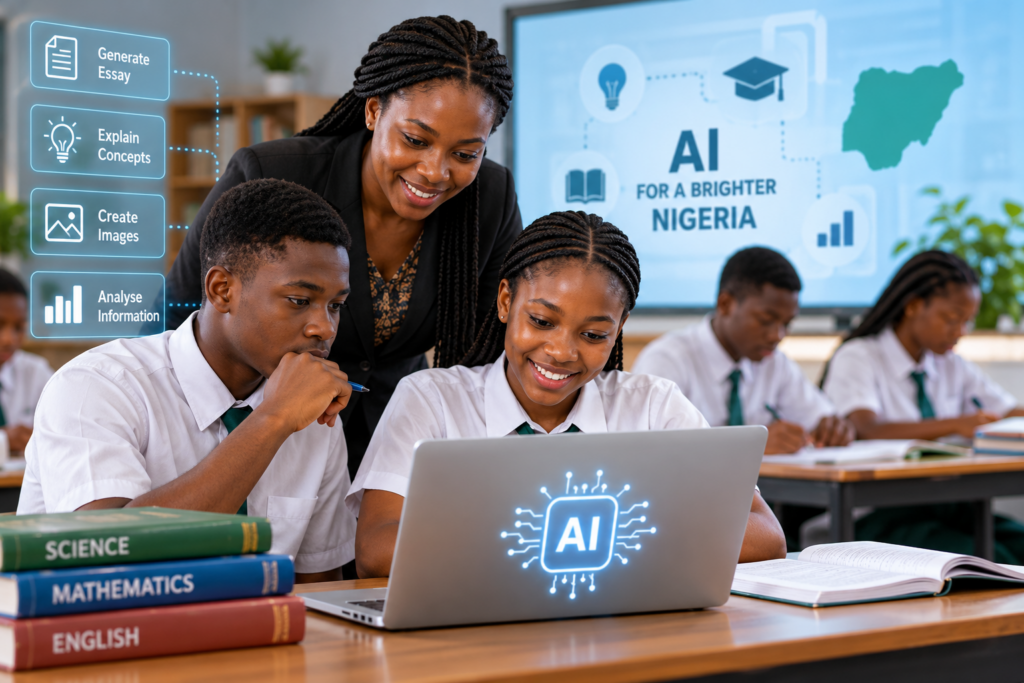
AI is already in Nigerian classrooms. The real question is whether schools are ready to use it well, from teacher training and student data protection to keeping critical thinking alive.
AI in Nigerian Schools: Are We Ready for the Future of Education?
Artificial intelligence can write essays in seconds, simplify complex subjects, create lesson plans, generate images, and analyse information. As these capabilities continue to improve, Nigerian schools must consider an important question:
Are our schools developing the skills and systems needed to keep pace with artificial intelligence?
AI presents significant opportunities to improve education, but it also raises important concerns about academic integrity, student privacy, critical thinking, and responsible technology use.
The conversation is no longer just about whether AI belongs in Nigerian classrooms. It is about how schools can adopt it responsibly while ensuring that students continue to develop the knowledge and skills they need to succeed.
How Artificial Intelligence Is Changing Education
AI is changing the way students learn and teachers prepare for lessons.
Students can use AI-powered tools to research topics, understand difficult concepts, brainstorm ideas, and practise answering questions. Teachers can use these technologies to prepare lesson plans, develop assessments, organise learning materials, and reduce repetitive administrative tasks.
For Nigerian schools, these capabilities could create new opportunities to improve teaching and learning, particularly when technology is introduced with clear educational objectives.
However, introducing AI should involve more than giving teachers and students access to digital tools.
Schools need to consider several important questions:
- What educational challenge are we trying to solve?
- Do teachers have the training required to use AI effectively?
- How will student information be protected?
- Does the technology support the school’s curriculum?
- How will we determine whether it improves learning outcomes?
Without clear answers, AI adoption could become another technology expense without delivering meaningful educational benefits.
The Biggest Risk Is Not Just Incorrect Information
One challenge with AI is that it can generate inaccurate information while presenting its answers confidently. Students who accept these responses without checking them may develop misconceptions or submit unreliable work.
However, the potential impact goes beyond misinformation.
What happens when students depend on AI instead of developing their own thinking skills?
If students rely on AI to write every essay, they may miss opportunities to improve their writing and communication skills.
If they use it to solve every mathematics problem, they may struggle to develop independent problem-solving abilities.
If they depend on it to generate every idea, they may have fewer opportunities to exercise their creativity.
This is why AI literacy should become an important part of modern education.
Students need to understand how AI works at a basic level, recognise its limitations, verify its claims, and decide when its use is appropriate. They should also understand the importance of academic honesty and follow their school’s rules on AI-assisted assignments.
The objective should not simply be to help students find answers faster. It should be to develop learners who can evaluate information, challenge assumptions, and think critically about the answers they receive.
Why Teachers Remain Essential in the Age of AI
AI can assist teachers with lesson preparation, assessment development, research, and administrative responsibilities. Used appropriately, it may help educators spend less time on repetitive tasks and more time supporting their students.
Nevertheless, effective teaching involves much more than delivering information.
Teachers observe students’ behaviour, recognise when someone is struggling, respond to individual learning needs, and understand the social and cultural circumstances that influence classroom experiences.
They also provide encouragement, guidance, mentorship, and human connection.
AI can support these responsibilities, but it should not be treated as a replacement for professional teaching.
For Nigerian schools to benefit from AI, teachers need practical training that helps them evaluate AI-generated materials, protect student information, identify inaccuracies, and integrate technology into their lessons without losing sight of educational goals.
Successful AI adoption starts with empowering teachers, not simply purchasing software.
Student Privacy Must Be a Priority
Another important consideration is how AI-powered educational platforms collect and process student information.
Before introducing an AI tool, schools should understand what information it requests, how the data is stored, who can access it, and whether it is used for additional purposes.
This is particularly important when platforms involve children or collect sensitive educational records.
Schools should also consider cybersecurity, parental awareness where appropriate, accessibility, and compliance with applicable data protection requirements.
A tool may be impressive in its capabilities without necessarily being suitable for every school environment.
Responsible AI adoption requires a careful assessment of privacy, security, affordability, accessibility, and educational value.
Should Nigerian Schools Be Afraid of Artificial Intelligence?
Not necessarily. However, they should approach it with clear objectives and appropriate safeguards.
AI can support personalised learning, assist teachers with lesson preparation, help students explore difficult concepts, and improve certain school administrative processes. Its actual benefits will depend on how well each tool addresses the needs of the school.
A practical approach for Nigerian schools could include the following steps:
- Develop clear AI policies: Explain when AI may be used for assignments, assessments, lesson preparation, and administrative work.
- Train teachers: Provide practical guidance on AI literacy, responsible use, fact-checking, and classroom integration.
- Educate students: Teach learners to verify information, protect their privacy, acknowledge AI assistance where required, and develop independent thinking.
- Evaluate educational tools: Assess whether each platform is appropriate for the curriculum, available infrastructure, budget, and students’ needs.
- Measure results: Monitor whether AI improves learning, reduces teachers’ workload, or addresses a clearly identified problem.
- Review policies regularly: Update school guidelines as technology, risks, and educational needs evolve.
Schools do not need to adopt every new AI product that enters the market. They need to identify where the technology can provide genuine value and introduce it in ways that support teachers and learners.
The most useful question is not simply, What can AI do for our school?
It is: What does our school need, and how can AI help us meet those needs responsibly?
The Future of Education Must Remain Human
Artificial intelligence will continue to influence education around the world, including Nigeria. Its growing role creates opportunities to improve access to learning resources, support educators, and make some school processes more efficient.
However, the future of education will still depend on skilled teachers, curious students, reliable information, responsible technology, and meaningful human relationships.
Education is not merely about producing correct answers. It is about helping people develop the ability to think independently, ask meaningful questions, solve problems, communicate effectively, and make informed decisions.
AI can contribute to that mission when it is used as a tool for learning rather than a substitute for learning itself.
At Olive, the conversation around educational technology should focus on how innovation can support better teaching, stronger learning outcomes, and more effective school management.
The future may be powered by artificial intelligence, but the purpose of education must remain the development of human potential.



0 comments